
Introduction to OST and PST Files
In the realm of email data management, two predominant file formats frequently emerge: OST and PST. Users of Microsoft Outlook are undoubtedly acquainted with these formats, yet their functional distinctions often become evident only when challenges arise.
An OST (Offline Storage Table) file facilitates offline access to mailbox data synchronized with an Exchange Server, whereas a PST (Personal Storage Table) file is primarily utilized for storing emails locally.
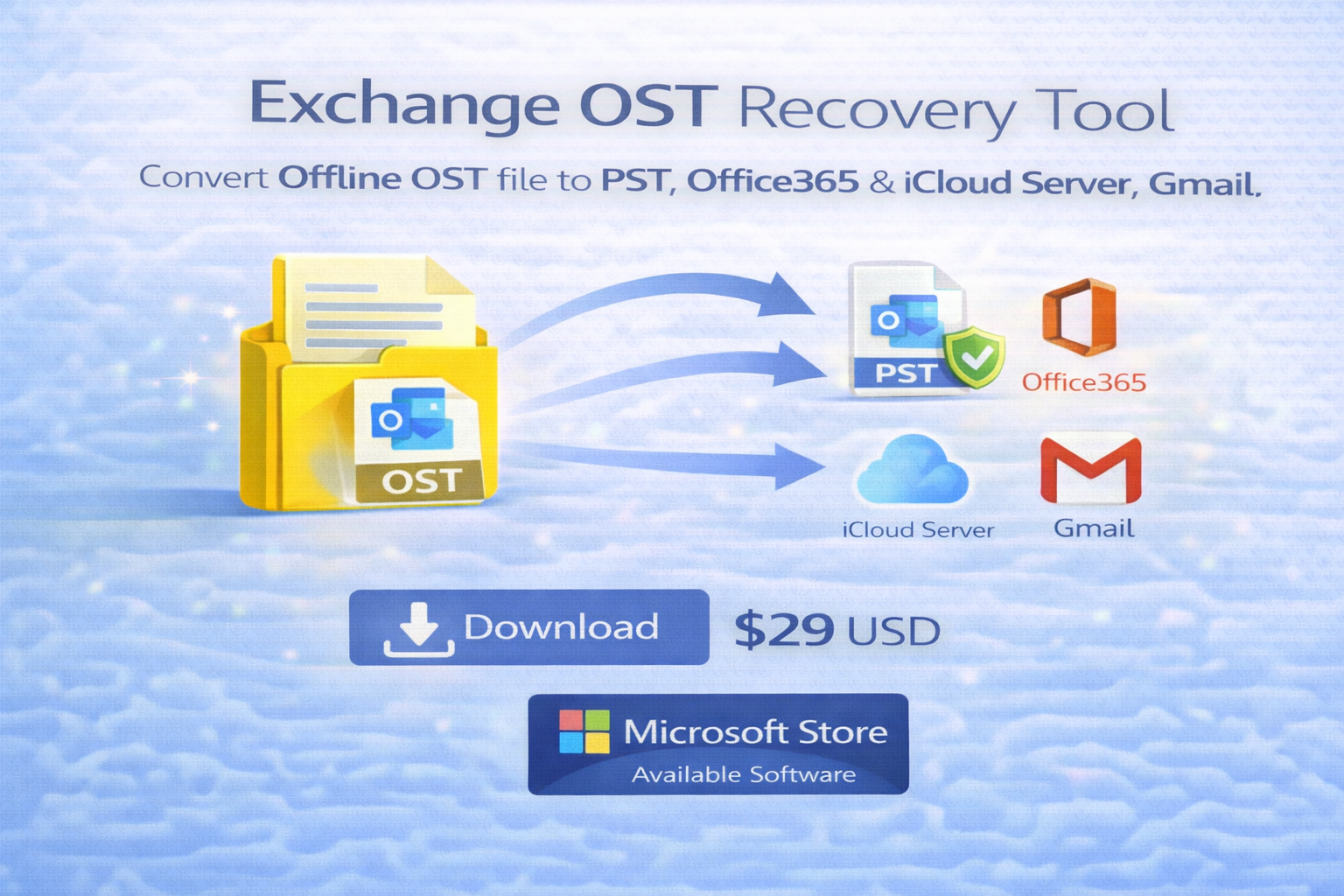
However, complications surface when users need to convert OST files into PST format—whether due to server disconnection, account deletion, or system migration. This is precisely where a robust OST to PST Converter becomes indispensable.
Envision accessing your critical emails, attachments, and contacts effortlessly after a streamlined conversion process. With the appropriate solution, what once seemed complex becomes remarkably simple and efficient.
Why Do You Need an OST to PST Converter?
Email file formats are not merely technical constructs—they directly influence accessibility and usability. OST files are intrinsically tied to Exchange Server environments, enabling offline productivity. However, if the server becomes inaccessible or the account is deactivated, the OST file essentially becomes orphaned.
In such scenarios, retrieving valuable mailbox data without specialized tools becomes nearly impossible. An OST to PST converter bridges this gap by transforming inaccessible OST data into a universally compatible PST format.
Without such a utility, critical emails may remain locked indefinitely. Conversely, conversion ensures seamless accessibility, enhanced data portability, and uninterrupted workflow continuity.
Furthermore, during system upgrades, data migration, or organizational restructuring, PST files provide a far more convenient and standardized format for data transfer.
Benefits of Utilizing an OST to PST Converter
Employing a professional OST to PST converter introduces a multitude of advantages that significantly enhance email management efficiency:
Data Integrity Preservation – Ensures emails, attachments, contacts, and calendar entries remain intact throughout the conversion process.
Bulk Conversion Capability – Facilitates simultaneous conversion of multiple OST files, optimizing productivity for enterprises and IT administrators.
Recovery of Corrupted Files – Advanced tools can extract data even from damaged or inaccessible OST files.
Enhanced Accessibility – Converts data into PST format, enabling easy access across various Outlook environments.
User-Friendly Interface – Designed with intuitive navigation, making it accessible for both technical and non-technical users.
Collectively, these benefits eliminate the complexities associated with manual methods and reduce dependency on technical support teams.
Key Features of the Recommended OST to PST Converter
A high-quality ATS OST to PST converter distinguishes itself through its advanced functionality and reliability. Below are some noteworthy features:
Intuitive User Interface – Simplifies complex operations, ensuring a seamless user experience.
Batch Conversion Support – Allows multiple OST files to be processed concurrently, saving valuable time.
Advanced Preview Functionality – Enables users to review emails, attachments, and mailbox items prior to conversion.
Data Fidelity Assurance – Maintains original folder hierarchy, metadata, and formatting without alteration.
Wide Compatibility – Supports multiple versions of Microsoft Outlook and Windows operating systems.
These features collectively establish the software as a dependable solution for both individual users and corporate environments.
How to Use the Converter – Step-by-Step Guide
The conversion process is designed to be straightforward and efficient:
Download and Install the OST to PST Converter from the official source.
Launch the Application and initiate the process.
Add OST File(s) by selecting the desired file from your system.
Preview Data to verify mailbox contents before conversion.
Select Output Format as PST and choose specific folders if required.
Define Destination Path to save the converted file.
Click on Convert and allow the software to process the data.
Upon completion, the PST file will be ready for seamless access in Microsoft Outlook.
Free Trial vs Full Version – What Sets Them Apart?
Understanding the distinction between the trial and full versions is essential before making a decision:
Free Trial Version:
Provides limited functionality
Allows preview of mailbox items
Restricts file size or number of conversions
Full Version:
Unlocks complete feature set
Enables unlimited file conversion
Supports large OST files
Includes technical support and regular updates
While the trial version is ideal for evaluation purposes, the full version is indispensable for comprehensive and uninterrupted usage.
Conclusion and Final Thoughts
Effective email management necessitates a clear understanding of OST and PST file structures. While OST files are optimized for offline synchronization with Exchange servers, PST files offer flexibility for storage, backup, and migration.
A reliable Microsoft OST to PST converter serves as a critical tool in bridging these formats, ensuring seamless data accessibility under all circumstances. Whether dealing with orphaned OST files, performing system migrations, or safeguarding critical communication data, such software provides a secure and efficient solution.
By investing in a feature-rich converter, users can eliminate technical barriers, safeguard data integrity, and significantly enhance operational efficiency. For both individual users and organizations, adopting a professional ATS OST to PST conversion tool is not merely a convenience—it is a strategic necessity in modern email data management.

Write a comment ...